


















How Does the Eye See Colors?
Reviewed by
Maria Horan FBDO
Color plays a central role in how we experience the world. From recognizing objects to appreciating art and fashion, our ability to perceive millions of colors relies on the way light interacts with the eye and brain.
Understanding how color perception works provides valuable insight into eye health and helps guide better eyewear choices.
Color is all around us
Although we describe objects as being red, blue, or green, the color does not exist in the object itself. Instead, color is the result of how light hits surfaces and how our eyes and brain process that light.
This complex interaction allows us to distinguish a vast range of shades and hues, contributing to human color perception.
The science behind color: light and wavelengths
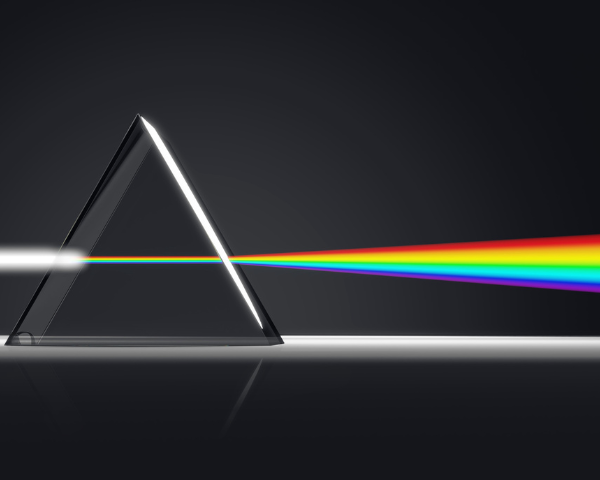
Light consists of electromagnetic waves, and each wavelength corresponds to a specific color. When light hits an object, some wavelengths are absorbed while others are reflected. The wavelengths that are reflected determine the color we perceive.
For example, an apple appears red because it reflects red light while absorbing other colors in the visible light spectrum.
The visible light spectrum includes all the colors the human eye can detect, ranging from violet at shorter wavelengths to red at longer wavelengths. This is part of the foundation of color science and how we see color in everyday life.
How light travels through the eye
For color vision to occur, light must first enter the eye and be focused onto the retina. Think of the eye like a camera. The process begins at the cornea, which acts like the camera’s outer lens, bending and directing light toward the pupil.
DID YOU KNOW?
Your ability to see color depends on just three types of cone cells in your retina, working together to process millions of color variations.
The pupil, much like a camera’s aperture, adjusts its size to control how much light passes through to the lens.
The lens then fine-tunes the focus, guiding the light onto the retina, where photoreceptor cells work like film in a traditional camera, starting the process of translating light into neural signals the brain can understand.
The role of rods and cones in the retina
The retina contains two primary types of photoreceptor cells: rods and cones. Each type serves a distinct purpose in vision. Rods are responsible for vision in low light. They’re highly sensitive and detect black and white, but not color.
Cones function in brighter light conditions and are essential for detecting color. There are three types of cones, each sensitive to different wavelengths of light:
- S-cones detect short wavelengths corresponding to blue cones.
- M-cones detect medium wavelengths corresponding to green cones.
- L-cones detect long wavelengths corresponding to red light.
By processing signals from these cones together, the brain can interpret millions of color variations. This system of red and green cones, along with blue cones, creates the foundation of human color vision.
The brain’s role: interpreting color signals
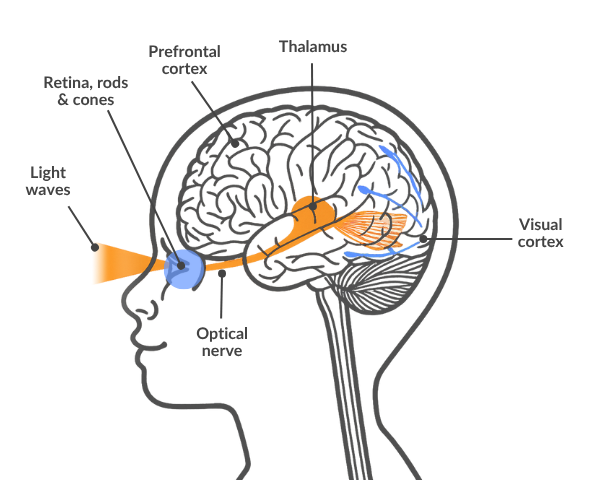
Once photoreceptors in the retina convert light into electrical signals, these signals travel along the optic nerve to the brain. It’s like sending a photo from a camera to a computer for editing.
The thalamus acts as the file manager, directing the signals to the visual cortex, where the brain processes and interprets the information, bringing the image into sharp, meaningful focus.
Just as photo-editing software can adjust for lighting and contrast, the brain takes into account lighting conditions, context, and memory.
This built-in adjustment, known as color constancy, helps maintain a consistent sense of color even when the lighting around us changes.
How many colors can we see?
The combination of signals from S, M, and L cones allows most people to distinguish approximately one million colors.
However, some individuals, known as tetrachromats, may have an additional type of cone cell that enables them to perceive an even wider range of colors.
Color vision varies across species. For comparison:
- Humans typically have trichromatic vision, relying on three cone types.
- Dogs have a limited color range, primarily seeing shades of blue and yellow.
- Birds and certain insects can perceive ultraviolet light, extending their visible spectrum beyond human capability.
What about color vision deficiency?
Color vision deficiency (CVD), sometimes called color blindness, happens when one or more types of cone cells in the eye don’t work properly. This affects how colors are seen and how light wavelengths are processed.
The most common type is red–green CVD, which makes it difficult to tell the difference between red and green tones. Blue–yellow CVD is less common and affects the ability to separate blue values from yellow.
Total color deficiency, known as achromatopsia, is rare and results in seeing only shades of gray.
CVD is much more common in men, around 1 in 12 males and 1 in 200 females are affected globally.
While there’s currently no cure, some people find that color vision lenses or specialist apps can help improve color contrast and support everyday tasks that rely on accurate color detection.
Why understanding color matters
Color perception plays a vital role in daily life, influencing areas such as safety, design, accessibility, and personal style.
For individuals with normal color vision and for those with color vision deficiencies, understanding how light hits the eye and how rods and cones process that light can help guide better eyewear decisions.
Frame colors, lens coatings, and tints can enhance both appearance and visual comfort under different lighting conditions, including brighter light and very low light levels.
More than meets the eye
The ability to see color relies on the partnership between light, photoreceptor cells, and the brain’s visual processing centers.
Blue cones, green cones, and red cones each respond to different wavelengths of light, working together to create the full range of human color perception.
This complex system allows humans to see an estimated one million colors within the visible light spectrum. Regular eye exams are essential for monitoring overall eye health, color vision accuracy, and peripheral vision.
At SmartBuyGlasses, our certified opticians offer professional support to help you select eyewear that enhances both visual clarity and color perception, ensuring optimal vision in every environment.
Related articles


Related articles