Prescription Lens Prices
Frame prices are easy to compare while you browse, but lens prices vary depending on what you choose, such as lens type, thickness, and other upgrades. This page outlines our US prescription lens prices for single vision, occupational, and progressive lenses, along with popular add-ons like blue light, Transitions®, tints, mirror finishes, and polarized upgrades.
Quick rule of thumb: your total = frame price + lens price + optional upgrades.
Jump to:
Frame prices are easy to compare while you browse, but lens prices vary depending on what you choose, such as lens type, thickness, and other upgrades. This page outlines our US prescription lens prices for single vision, occupational, and progressive lenses, along with popular add-ons like blue light, Transitions®, tints, mirror finishes, and polarized upgrades.
Quick rule of thumb: your total = frame price + lens price + optional upgrades.
How lens pricing works
Lens pricing comes down to three choices:
1. Lens type: single vision, occupational, or progressive
2. Lens thickness (index): standard to thinner options (often helpful for stronger prescriptions)
3. Optional upgrades: blue light, Transitions®/photochromic, tints, mirror, polarized, and more
You’ll see your exact total in checkout before you pay. This page is meant to set clear expectations and help you compare options quickly.
How lens pricing works
Lens pricing comes down to three choices:
- Lens type: single vision, occupational, or progressive
- Lens thickness (index): standard to thinner options (often helpful for stronger prescriptions)
- Optional upgrades: blue light, Transitions®/photochromic, tints, mirror, polarized, and more
You’ll see your exact total in checkout before you pay. This page is meant to set clear expectations and help you compare options quickly.
Choose your lens type
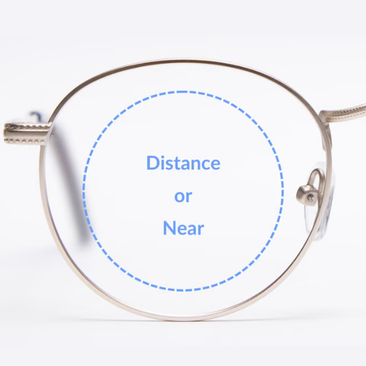
Single vision
Single vision lenses correct one viewing distance. They’re the most common choice for everyday wear and can help with:
- Nearsightedness (myopia)
- Farsightedness (hyperopia)
- Astigmatism
- Single-vision reading prescriptions
Occupational (book and desk distances)
Occupational lenses are designed for the distances you use most at work, like screens and desk tasks. They’re a great option if you want comfortable near and mid-range vision without a multi-distance progressive setup.
Progressive (multi-distance)
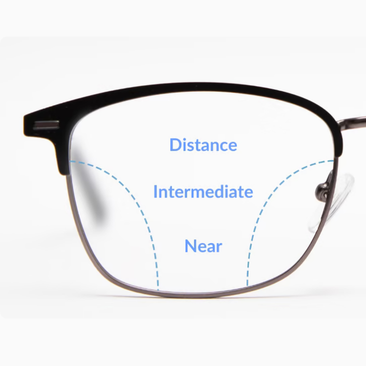
Progressives combine distance, intermediate, and reading vision in one lens with a smooth transition and no visible lines. If you’re experiencing presbyopia, which is often an age-related near-vision change, progressives are a common all-in-one solution.
Choose your lens type (what it helps with)
Single vision
Single vision lenses correct one viewing distance. They’re the most common choice for everyday wear and can help with nearsightedness, farsightedness, astigmatism, andsingle-vision reading prescriptions
Occupational (book and desk distances)
Occupational lenses are designed for the distances you use most at work, like screens and desk tasks. They’re a great option if you want comfortable near and mid-range vision without a multi-distance progressive setup.
Progressive (multi-distance)
Progressives combine distance, intermediate, and reading vision in one lens with a smooth transition and no visible lines.
Designer Brands vs Exclusive Brands
Lens prices can vary depending on the type of frame you choose:
When you choose a frame, it will fall into one of these two categories. The corresponding lens prices will apply when you select your lenses.
If you’re comparing totals, house brand frames can often be a straightforward way to keep the overall cost lower while still having access to the same lens types and upgrades.
Lens thickness (index): when it matters
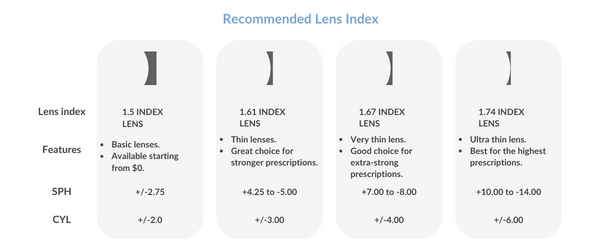
Lens index mainly affects thickness, comfort, and overall appearance. Higher index lenses can be thinner and lighter, especially for stronger prescriptions. If your prescription is mild, standard options are often a good fit.
It also plays a role in the cosmetic result: with a high plus prescription, a standard 1.5 index can make the eyes appear larger, while a higher index helps reduce this magnification for a more natural look.
Typical index choices:
- 1.50 (standard)
- 1.61 / 1.67 / 1.74 (thinner options)
Polycarbonate (lightweight, impact-resistant material where available)
Upgrades & add-ons: choose what you’ll actually use
Upgrades are optional.The simplest approach is to start with your day-to-day needs.
- Lots of screen time: consider blue light filtering
- Moving between indoors and outdoors often: photochromic or Transitions®
- Glare sensitivity or driving comfort: polarized options
- Style: tints, mirror finishes, color matching
Some add-ons show a “From X to Y” range because the final cost depends on your lens index or configuration. You’ll see the exact price once you select your lens setup in checkout.
How lens pricing works
Upgrades are optional.The simplest approach is to start with your day-to-day needs.
– Lots of screen time: consider blue light filtering
– Moving between indoors and outdoors often: photochromic or Transitions®
– Glare sensitivity or driving comfort: polarized options
– Style: tints, mirror finishes, color matching
Some add-ons show a “From X to Y” range because the final cost depends on your lens index or configuration. You’ll see the exact price once you select your lens setup in checkout.
U.S. lens price tables (USD)
Single vision lens prices
Lens option | Designer Brands | Exclusive Brands |
Standard (1.5 uncoated) | Free | Free |
Comfort (1.5 coated) | $39 | $24 |
Polycarbonate | $49 | $49 |
Thin & Light (1.61) | $69 | $59 |
Ultra (1.67) | $99 | $79 |
Deluxe (1.74) | $139 | $109 |
Arise Clarity Active-X (1.5 coated) | $69 | $39 |
Arise Clarity Pro-X (1.61) | $99 | $69 |
Arise Clarity Ultra-X (1.67) | $129 | $99 |
Arise Clarity Elite-X (1.74) | $179 | $179 |
Occupational lens prices
Lens option | Designer Brands | Exclusive Brands |
Standard (1.5 uncoated) | $69 | $69 |
Comfort (1.5 coated) | $99 | $99 |
Polycarbonate | $109 | $109 |
Thin & Light (1.61) | $119 | $119 |
Ultra (1.67) | $139 | $139 |
Deluxe (1.74) | $179 | $179 |
Arise Clarity Active-X (1.5 coated) | $109 | $109 |
Arise Clarity Pro-X (1.61) | $169 | $169 |
Arise Clarity Ultra-X (1.67) | $209 | $209 |
Arise Clarity Elite-X (1.74) | $249 | $249 |
Progressive lens prices
Lens option | Designer Brands | Exclusive Brands |
Standard (1.5 uncoated) | $99 | $99 |
Comfort (1.5 coated) | $149 | $119 |
Polycarbonate | $159 | $129 |
Thin & Light (1.61) | $169 | $139 |
Ultra (1.67) | $189 | $159 |
Deluxe (1.74) | $229 | $199 |
Arise Clarity Active-X (1.5 coated) | $149 | $139 |
Arise Clarity Pro-X (1.61) | $169 | $159 |
Arise Clarity Ultra-X (1.67) | $189 | $199 |
Arise Clarity Elite-X (1.74) | $299 | $299 |
Add-ons and upgrades
Add-on | Designer Brands | Exclusive Brands |
zFort Blue Light | From $29 to $39 | From $25 to $39 |
Photochromic | From $59 to $89 | From $59 to $89 |
Transitions Gen S | From $109 to $249 | From $109 to $249 |
Transitions Xtractive | From $129 to $159 | From $129 to $159 |
Transitions Xtractive Polarized | From $199 to $239 | From $199 to $239 |
Tints | $29 | $19 |
Mirror | From $39 to $59 | From $29 to $59 |
Polarized | From $69 to $99 | From $59 to $99 |
Color Matching | $29 | $29 |
Estimate your total (frames + lenses)
Once you’ve chosen your lenses, adding the frame price is straightforward. In the US, frames start from $7.
A simple way to estimate:
- Add your frame price
- Pick your lens type (single vision / occupational / progressive)
- Choose thickness/index if you need it
- Add any upgrades (optional)
You’ll see the final total in checkout before placing your order.
Frequently Asked Questions
Lens pricing depends on your configuration, including lens type, thickness or index, and upgrades. Checkout is where you build your exact lens package and see the full total before you pay.
Yes.Standard (1.5 index uncoated) single vision lenses are free for both DB and HB. Other lens types (occupational and progressive) have their own pricing.
Single vision lenses correct vision for one specific distance—near, intermediate, or far—depending on your prescription. They are designed for one task only, unlike progressive lenses, which combine all three distances in a single lens.
Occupational lenses are designed for near and mid-range use, such as desk and screen distances. Progressives combine distance, intermediate, and reading in one lens without visible lines.
Thinner lenses can help reduce thickness and weight for stronger prescriptions. If your prescription is mild, standard options often work well.
Some add-ons vary by lens index or configuration. We show a clear expectation range here, and your exact add-on price appears in checkout once your lens setup is selected.
You’ll need a valid prescription and your pupillary distance (PD), which is the distance between the centers of your pupils measured in millimiters, used to align lenses in glasses.. We guide you step-by-step during the lens selection process.
Yes. Depending on your prescription, lenses can correct common needs like nearsightedness, farsightedness, astigmatism, presbyopia, and multi-distance vision changes. If you’re unsure, start with how you use your glasses most, such as everyday wear, screens, reading, or driving.

Ready to build your pair?
Choose a frame, then select the lenses that match your needs. You’ll always see your exact total in checkout before you place your order.
Ready to build your pair?
Choose a frame, then select the lenses that match your needs. You’ll always see your exact total in checkout before you place your order.